A few days ago, I listened to a Beach Boys Christmas album, and I noticed something about their version of "Blue Christmas." At about 2:00, some brass instruments (I think French horns) quote a phrase from George Gershwin's Rhapsody in Blue. I can't find a score of the Rhapsody in Blue in order to look up the notation, and the phrase is too complex for my novice notation skills, but in "Blue Christmas," the phrase is D, Eb, F, and then an F an octave lower. In the Rhapsody in Blue, it's G#, A, B, and then a B an octave lower. (In the recording of Rhapsody in Blue I have by the Royal Philharmonic Orchestra, it's at about 11:31.) It's the same phrase, just transposed down for "Blue Christmas." (For what it's worth, it's also the phrase that starts "Rhapsody in Blue (Reprise)" on Brian Wilson's Reimagines Gershwin album, although that's E, F, G, and then a G an octave lower).
I did some research and discovered (in the entry for 18 June 1964 in Keith Badman's The Beach Boys: The Definitive Diary of America's Greatest Band on Stage and in the Studio) that the Beach Boys' version of "Blue Christmas" was arranged by Dick Reynolds. While Wilson didn't arrange it himself, he probably had a hand in putting in that quotation because he's acknowledged Gershwin's influence and mentioned Rhapsody in Blue in particular. The Reimagines Gershwin album provides ample evidence.
Purely as a reference, it's also interesting because "blue" is in the title of both works (and in the lyrics of "Blue Christmas"). To some degree, quoting Gershwin's Rhapsody in Blue gives more depth to "Blue Christmas." There's the feeling of "Blue Christmas" itself, but then - because of that quotation - there's an injection of the feeling of the Rhapsody in Blue too.
I transcribed "Blue Christmas" when I listened to the album a second time, and I found something interesting about the song itself, not just the Beach Boys' version. The lines in the first verse all have line-ending rhymes ("without you" rhymes with "about you," and "tree" rhymes with "me"), but that same structure isn't in the second verse. The first two lines rhyme ("certain" with "hurtin'"), but not "You'll be doin' alright with your Christmas of white / But I'll have a blue, blue Christmas." Instead of line-ending rhymes, there's internal rhyme in the third line ("alright" and "white") and no rhyme at all in the fourth line, either within the line itself or with any other line. That surfeit of rhyme in the third line and the lack of rhyme in the fourth poetically mirror the lyrics themselves. "You'll be doin' alright" with internal rhyme, "But I'll have a blue, blue Christmas" with no rhyme at all.

Monday, December 14, 2015
Monday, December 7, 2015
Fleet Foxes' Helplessness Blues
A couple years ago, I noticed that Innisfree is mentioned in a couple songs on Fleet Foxes' Helplessness Blues. I'd wondered if it was related to Yeats' "The Lake Isle of Innisfree," but until recently, I'd never really looked into it. In doing so, I found some other interesting things too.
I should note that I took the lyrics from the gatefold of the vinyl version:

However, they're not exactly what's on the album itself. There are some differences between what's written and what's sung, and some of the line breaks occur in weird places. The songs on the album are also in a different order than that in the gatefold, but that might be just because of the space the lyrics require when written out.
There's an interesting feature here with doubles. The song starts with the lines "I was raised up believin’ I was somehow unique / Like a snowflake, distinct among snowflakes / Unique in each way you’d conceive," and there's one voice and one guitar. But after the lines "I’d rather be / A functioning cog in some great machinery / Serving something beyond me," a second voice, a second guitar, and harmonium come in (during the line "But I don’t, I don’t know what that will be").
Later, there's the opposite effect: at the "know" in "If I know only one thing," the second guitar drops out. There are still two voices, but now there's only one guitar and one harmonium, so there's an exclusivity to match the "one thing" in the lyric.
For both, the strumming pattern of the guitar(s) matches the number. If there's only one guitar, the strums are all (or at least mostly) downward, but if there are two, the strums are upward and downward.
The "Old news, old news to you then" line is interesting in that - through its repetitions - it itself becomes old news. Furthermore, there's a sort of motif in the melody to which it's sung:

(click the image to enlarge it)
(I'm fairly confident in this notation, although I might have the key wrong)
For the first three words ("Old news, old..."), each word lasts one measure and is comprised of two eighth notes and a half note. The first eighth note and the half note are the same pitch, and the second eighth note is one step above the other two notes (sometimes a half-step, sometimes a whole-step). For the last "news," there are two quarter notes (continuing downward like the rest of the phrase) instead of a half note.
Almost every "Old news, old news" section has this melody, so there's the repetition of the phrase as a whole, and there's the repetition of that three-note motif within the phrase. The only one that doesn't have this melody is the one that's after the line "Fell for the ruse with you then." Instead, it becomes:

That line ("Fell for the ruse...") has its place in the narrative of the song, but it also affects the "Old news..." section that follows it. The melody itself "fell for the ruse," was deceived, and changed.
Like the second voice in "Helplessness Blues," a second voice comes in for the line "I walk with others."
The phrase "gnash their teeth" seems to be a Biblical reference. It's actually in a few places in Matthew where Jesus explains some parables, but Matthew 13:41-42 is probably the most easily quotable: "The Son of Man will send his angels, and they will gather out of his kingdom all causes of sin and all law-breakers, and throw them into the fiery furnace. In that place there will be weeping and gnashing of teeth."
The strumming pattern emphasizes "Claw" and "gnash" in the line "Claw at my skin and gnash their teeth and shout." They both occur on the first beat of the bar, and that first beat is a quarter note where the other beats are eighth notes, so that first beat (and the impact of those words) stands out:

(click the image to enlarge it)
I should note that my notation is accurate only as far as the guitar strumming, not the tonality. I used B notes just because they're in the middle of the staff.
I should note that I took the lyrics from the gatefold of the vinyl version:

However, they're not exactly what's on the album itself. There are some differences between what's written and what's sung, and some of the line breaks occur in weird places. The songs on the album are also in a different order than that in the gatefold, but that might be just because of the space the lyrics require when written out.
"Bedouin Dress"
At "return" in the line "Everything I took I’d soon return," more instruments come in, and the dynamics increase, as if to reflect the returning. Similarly, once the next line starts ("Just to be at Innisfree again") there's a harmony vocal that continues throughout the rest of the song.
In the gatefold, the second half of the last verse is rendered as:
This is the first track on the album that mentions Innisfree, but there's not that much in common between this and Yeats' poem. Both narrators want to go to Innisfree (Yeats' poem starts with "I will arise and go now, and go to Innisfree," and here there's "Everything I took I’d soon return / Just to be at Innisfree again"), and both are looking for peace (there's "And I shall have some peace there..." in Yeats, and "Everything I took I’d soon return / Just to be at Innisfree again" from "Bedouin Dress" seems to hint at the same feeling).
In the gatefold, the second half of the last verse is rendered as:
Gleaming white, just as I recalledStandardized and following what's actually on the album, it's more like:
Old as I get,
I would never forget it at all.
Gleaming white, just as I recallThe printed lyrics have only "I would never forget it," but on the album, there's also "I could never forget it."
Old as I get, I would never forget it at all
Gleaming white, just as I recall
Old as I get, I could never forget it at all
This is the first track on the album that mentions Innisfree, but there's not that much in common between this and Yeats' poem. Both narrators want to go to Innisfree (Yeats' poem starts with "I will arise and go now, and go to Innisfree," and here there's "Everything I took I’d soon return / Just to be at Innisfree again"), and both are looking for peace (there's "And I shall have some peace there..." in Yeats, and "Everything I took I’d soon return / Just to be at Innisfree again" from "Bedouin Dress" seems to hint at the same feeling).
"Sim Sala Bim"
When the "Then the earth shook..." verse starts, violin tremolos begin, providing a sense of trembling.
I think it's fairly obvious, but the couplet at the end ("Remember when you had me cut your hair? / Call me 'Delilah' then I wouldn’t care") is an allusion to Samson and Delilah in Judges 16.
I think it's fairly obvious, but the couplet at the end ("Remember when you had me cut your hair? / Call me 'Delilah' then I wouldn’t care") is an allusion to Samson and Delilah in Judges 16.
"The Plains/Bitter Dancer"
The second verse starts and ends with the line "You took a room and you settled in." While the next verse does the same thing (with "I should have known one day you would come"), repeating the line with "you settled in" emphasizes the certainty of the settling in. It implies that the "you" will be there for a rather long time.
At the end, the line "At arm's length I will hold you there, there" is repeated, but it's not present in the gatefold lyrics, which actually mirrors the sentiment pretty well. There's a cautiousness in holding someone "at arm's length," just as there is in not including those lyrics in the gatefold.
"Helplessness Blues"
There's an interesting feature here with doubles. The song starts with the lines "I was raised up believin’ I was somehow unique / Like a snowflake, distinct among snowflakes / Unique in each way you’d conceive," and there's one voice and one guitar. But after the lines "I’d rather be / A functioning cog in some great machinery / Serving something beyond me," a second voice, a second guitar, and harmonium come in (during the line "But I don’t, I don’t know what that will be").Later, there's the opposite effect: at the "know" in "If I know only one thing," the second guitar drops out. There are still two voices, but now there's only one guitar and one harmonium, so there's an exclusivity to match the "one thing" in the lyric.
For both, the strumming pattern of the guitar(s) matches the number. If there's only one guitar, the strums are all (or at least mostly) downward, but if there are two, the strums are upward and downward.
"Lorelei"
To some degree, the repeated "you" in the line "You, you were like glue" gives a sense of the adhesiveness of glue. It's almost as if the word stuck to itself when it was put into the song.
The parallelism in the line "Call out to nobody, call out to me" equates "nobody" with "me," which is the same idea in "I was like trash on the sidewalk" and "I was old news to you."

(click the image to enlarge it)
(I'm fairly confident in this notation, although I might have the key wrong)
For the first three words ("Old news, old..."), each word lasts one measure and is comprised of two eighth notes and a half note. The first eighth note and the half note are the same pitch, and the second eighth note is one step above the other two notes (sometimes a half-step, sometimes a whole-step). For the last "news," there are two quarter notes (continuing downward like the rest of the phrase) instead of a half note.
Almost every "Old news, old news" section has this melody, so there's the repetition of the phrase as a whole, and there's the repetition of that three-note motif within the phrase. The only one that doesn't have this melody is the one that's after the line "Fell for the ruse with you then." Instead, it becomes:

That line ("Fell for the ruse...") has its place in the narrative of the song, but it also affects the "Old news..." section that follows it. The melody itself "fell for the ruse," was deceived, and changed.
"Someone You'd Admire"
Like the second voice in "Helplessness Blues," a second voice comes in for the line "I walk with others."The phrase "gnash their teeth" seems to be a Biblical reference. It's actually in a few places in Matthew where Jesus explains some parables, but Matthew 13:41-42 is probably the most easily quotable: "The Son of Man will send his angels, and they will gather out of his kingdom all causes of sin and all law-breakers, and throw them into the fiery furnace. In that place there will be weeping and gnashing of teeth."
The strumming pattern emphasizes "Claw" and "gnash" in the line "Claw at my skin and gnash their teeth and shout." They both occur on the first beat of the bar, and that first beat is a quarter note where the other beats are eighth notes, so that first beat (and the impact of those words) stands out:

(click the image to enlarge it)
I should note that my notation is accurate only as far as the guitar strumming, not the tonality. I used B notes just because they're in the middle of the staff.
"The Shrine/An Argument"
I think the first pair of lines in these verses are really long, rhyming "dawn" with "gone" and "shrine" with "fine." In the gatefold lyrics though, there are some really interesting line breaks that seem to have some extra meaning.
The gatefold renders a section from the first verse as:
Underneath were all these pennies
Fallen from the hands of
Children they were there and
Then were gone.
The line breaks occur at places of separation: the pennies from the hands, and the children's being there and being gone. The second verse, as renders in the gatefold lyrics, has something similar:
But that day, you know, I left
My money and I thought of you only
Here, there's the separation of the speaker/singer from his money.
There's a weird metrical strain in the line "In the driveway, pulling away, putting on your coat." I don't understand meter enough to be able to diagram or illustrate this, but the "away" is stressed on the first syllable instead of the second. The resulting strain seems to betray the speaker/singer's frisson.
In the line "In the ocean washin’ off my name from your throat," there's a similar sound in the "c" of "ocean" and the "sh" of "washin'." Purely poetically, this is just consonance, but it also suggests scouring or scraping something clean, which is more explicitly present in the "washin'" itself.
There are two features here that seem to connect this song with "Helplessness Blues." First, there's "I left my money, and I thought of you only, all that copper glowin’ fine." It's kind of ambiguous whether the "copper glowin' fine" is a literal description of the money or a figurative description of "you" (that is, the person's hair). If it's the second, it's similar to "Gold hair in the sunlight" in "Helplessness Blues." Second, both mention apples. There's the line "Green apples hang from my tree" near the end of "The Shrine/An Argument," and "Helplessness Blues" has a number of lines beginning with "If I had an orchard...." In looking through the album's lyrics, I noticed quite a lot of similar descriptions in various songs. I'm still not sure what to make of some of the others, but this one seemed to be one of the most connected, which is why I'm mentioning it.
This is the second song on the album that mentions Innisfree, and there's more that would seem to connect this to Yeats' poem than there is in "Bedouin Dress," but still not enough to say that it was intentional. Both use a lot of natural imagery, but there's only one that they have in common. The last few lines of "The Shrine/An Argument" are:
And if I just stay a while here, starin' at the sea
And the waves break ever closer, ever near to me
I will lay down in the sand and let the ocean lead
Carry me to Innisfree like pollen on the breeze
There are image of water (the sea, the waves, and the ocean), which is somewhat similar to the tenth line of "The Lake Isle of Innisfree" - "I hear lake water lapping with low sounds by the shore."
Between this and "Bedouin Dress," there really isn't anything that specifically references Yeats' poem. If anything, Innisfree is used just in the same general sense of a peaceful, natural place.
"Grown Ocean"
It doesn't really make a difference to the meaning of the line, but "Kept like jewelry kept with devotion" could be parsed in two different ways. As it is in the gatefold rendering, because there's no comma, "kept with devotion" is modifying the "jewelry." With a comma, both "kept like jewelry" and "kept with devotion" modify the "children grown on the edge of the ocean" from the previous line.
This song ends with:
This song ends with:
Wide-eyed walker, don’t betray me
I will wake one day, don’t delay me
Wide-eyed leaver, always going
The "wide-eyed walker" appears earlier on the album in "Battery Kinzie":
Wide-eyed walker
Do not wander
Do not wander through the dawn
Like the features that seem to tie together "Helplessness Blues" and "The Shrine/An Argument," this was one of the stronger inter-song connections I found on the album.

Monday, November 30, 2015
The Byrds' Sweetheart of the Rodeo
Since 20 January (the 50th anniversary of their first studio session on 20 January 1965), I've been reading Christopher Hjort's So You Want to Be a Rock 'n' Roll Star: The Byrds Day-by-Day 1965-1973. A month or two ago, I reached August 1968, when Sweetheart of the Rodeo was released (on 30 August according to Hjort and the liner notes of my CD reissue). It's probably my favorite Byrds album (although I've heard only the first six so far), so after reading about it, I listened to it a few times and found a few interesting things.
"I’m going down to the River of Jordan / Just to bathe my wearisome soul" is a reference to Naaman in the Old Testament. In 2 Kings 5, the prophet Elisha tells Naaman to dip himself in the Jordan River seven times to be cured of his leprosy.
The other reference is in the lines "If I can just touch the hem of His garment, good Lord / Then I’d know He’d take me home." Recounted in three different books of the New Testament (Matthew 9, Mark 5, and Luke 8), a woman is healed from a discharge of blood after touching only the fringe of Jesus' garment.
(I feel it's also worth mentioning that last September I wrote about some similarities between "I Am a Pilgrim" and "Wayfaring Stranger" as part of my Collection Audit project.)
In both versions, there seems to be a discrepancy between the lead and backing vocals during the line "For what is a friend who'd want you to fall." The lead vocals seem to have "who'd want" where the backing vocals have "who wants."
"I Am a Pilgrim"
I'm surprised I didn't realize this earlier, but there are two Biblical stories mentioned in the lyrics."I’m going down to the River of Jordan / Just to bathe my wearisome soul" is a reference to Naaman in the Old Testament. In 2 Kings 5, the prophet Elisha tells Naaman to dip himself in the Jordan River seven times to be cured of his leprosy.
The other reference is in the lines "If I can just touch the hem of His garment, good Lord / Then I’d know He’d take me home." Recounted in three different books of the New Testament (Matthew 9, Mark 5, and Luke 8), a woman is healed from a discharge of blood after touching only the fringe of Jesus' garment.
(I feel it's also worth mentioning that last September I wrote about some similarities between "I Am a Pilgrim" and "Wayfaring Stranger" as part of my Collection Audit project.)
"The Christian Life"
The CD version I have of Sweetheart of the Rodeo includes bonus tracks, one of which is a rehearsal of "The Christian Life." After listening to both, I discovered that the two versions flip the first line of the two verses. In the version on the final album, the first verse starts with "My buddies tell me that I should have waited" and the second with "My buddies shun me since I turned to Jesus," but in the other version, the first verse starts with "My buddies shun me since I turned to Jesus" and the second with "My buddies tell me that I should have waited."In both versions, there seems to be a discrepancy between the lead and backing vocals during the line "For what is a friend who'd want you to fall." The lead vocals seem to have "who'd want" where the backing vocals have "who wants."
"You're Still on My Mind"
Lately, I've been really interested in melismas that add meaning to the lyric. "You're Still on My Mind" has some of them with the "heart" in the line "An empty bottle, a broken heart, and you’re still on my mind" that ends each verse. Where "heart" would normally have only one syllable, it has two here, so it sounds "broken." Oddly, though, that melisma isn't present in every verse. It's in the first verse and the repeated line in the third verse. In the rehearsal version (included as a bonus track), it's in the second verse and that repeated line in the third verse."You Got a Reputation" [Bonus Track]
Like the melismas on "heart" in "You're Still on My Mind," there are some interesting melismas on "down" in a few of the various "You’re just tearin’ your own reputation down" lines. They're slight, but some of those "down"s have multiple syllables, and later syllables are at a lower pitch than earlier ones. So the word "down" is falling, pitch-wise.
Monday, November 23, 2015
Smokey Robinson & the Miracles' Cookin' with the Miracles
A few months ago, I listened to a two-CD set of Smokey Robinson & the Miracles, and recently I listened to it a second time so I could write about it. It includes their first two albums, Hi... We're the Miracles and Cookin' with the Miracles, with some bonus tracks. I noticed some interesting things about a few songs on Cookin' with the Miracles.

"Everybody's Gotta Pay Some Dues"
The opening part of this has a rhythm that's very similar to that in Ravel's Boléro (or, apparently, any boléro). A month or so before I discovered it in this Miracles song, I also found it in a Jacques Brel song, so I just re-purposed the diagram I made for that:

(click the image to enlarge it)
(notation for Ravel's Boléro found here)
I'll include the same disclaimer from that Brel post: it's entirely possible that I've done the notation wrong. Also, I didn't mean to indicate B notes, but I couldn't format my notation like it should be for percussion (with only one line).
"You Never Miss a Good Thing"
I noticed the lines "I know you might miss your water / When the well runs dry," which I think might be a reference to an-other song, but I'm not sure which one. I have two other songs in my collection that have titles (and lines) similar to those lines: Ray Charles' "(You'll Never Miss the Water) Until the Well Runs Dry" and the Byrds' "You Don't Miss Your Water" from Sweetheart of the Rodeo (with the line "You don’t miss your water til your well runs dry"). Obviously the Byrds' version (from 1968) post-dates this Miracles song, but as a song, "You Don't Miss Your Water" was apparently first released in 1961 - the same year as Cookin' with the Miracles. If nothing else, all three songs use the same imagery.
"Embraceable You"
The Gershwins' "Embraceable You" is probably the most-performed song in my collection, but after hearing the Miracles' version I understood a different sense of the line "I love all the many charms about you." I think the Miracles' slow tempo had something to do with perceiving it differently. I'd always understood that line relatively plainly, where "about" has the sense of "pertaining to." But it could also have the sense of "surrounding" - the same sense that it has in the next line: "Above all, I want my arms about you."
With that "surrounding" sense, it becomes similar to a line earlier in the song: "Just one look at you, my heart goes tipsy in me." In the same way that a look can make the speaker/singer tipsy, there's almost an intoxicating cloud of charm around the titular "you" that also affects the speaker/singer.
Saturday, November 21, 2015
Mendelssohn: Concerto in A minor for piano and strings
For the last three days, I've listened to Mendelssohn's Concerto in A minor for my CMQ project (I was reading a Mendelssohn biography last February, which is why that piece was in the queue so much). The first time I listened to it for the CMQ (which was only the second time I'd ever listened to it), I noticed a phrase in the strings near the beginning of the first movement (it's also near the end of the movement). It took a few minutes to place, but I eventually remembered that Mozart's "Eine kleine Nachtmusik" (Serenade No. 13 in G major K. 525) starts with a similar phrase.
I looked up the scores for both so I could compare them. I had a bit of trouble with the Mendelssohn concerto in that the only notation I could find is apparently the original manuscript. Mendelssohn wrote it when he was pretty young, and I don't think it was actually printed. Because it was hand-written, there's a greater likelihood that I miscounted my measures.
In any case, when I looked up the notation and found the part I'd heard, I was surprised by how similar it is to Mozart's phrase. While they're an octave lower, the first six pitches are the same, and the first five note values are the same.
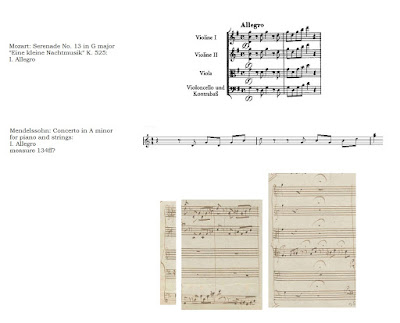
(click the image to enlarge it)
(notation found here [Mozart's Serenade] and here [Mendelssohn's Concerto])
The middle line is my standardized rendering of the two violin parts in Mendelssohn's Concerto; at the beginning of that line, there are two treble clefs, and I'm assuming that it means that the two violin parts there are the same. I was going to do the same for the viola and bass parts, but I had some difficulties with my program. I found the original manuscript a bit difficult to read, but I think those other string parts match Mozart's too.
I went back and referenced the Mendelssohn biography I'd read (R. Larry Todd's Mendelssohn: A Life in Music) to see if I could find anything about this Mozart quotation. Todd mentions Mendelssohn's being "thoroughly captivated" by Johann Hummel's A minor piano concerto and that Hummel was a student of Mozart, and he also says that Mendelssohn's concerto "marks an impressive achievement of an apprentice, who anticipated elements of his own mature style while he assimilated the legacy of Mozart's concerti and tested Hummel's innovations in piano technique." There isn't anything there about that quotation of Mozart's serenade, but clearly Mozart was an influence.
I looked up the scores for both so I could compare them. I had a bit of trouble with the Mendelssohn concerto in that the only notation I could find is apparently the original manuscript. Mendelssohn wrote it when he was pretty young, and I don't think it was actually printed. Because it was hand-written, there's a greater likelihood that I miscounted my measures.
In any case, when I looked up the notation and found the part I'd heard, I was surprised by how similar it is to Mozart's phrase. While they're an octave lower, the first six pitches are the same, and the first five note values are the same.

(notation found here [Mozart's Serenade] and here [Mendelssohn's Concerto])
The middle line is my standardized rendering of the two violin parts in Mendelssohn's Concerto; at the beginning of that line, there are two treble clefs, and I'm assuming that it means that the two violin parts there are the same. I was going to do the same for the viola and bass parts, but I had some difficulties with my program. I found the original manuscript a bit difficult to read, but I think those other string parts match Mozart's too.
I went back and referenced the Mendelssohn biography I'd read (R. Larry Todd's Mendelssohn: A Life in Music) to see if I could find anything about this Mozart quotation. Todd mentions Mendelssohn's being "thoroughly captivated" by Johann Hummel's A minor piano concerto and that Hummel was a student of Mozart, and he also says that Mendelssohn's concerto "marks an impressive achievement of an apprentice, who anticipated elements of his own mature style while he assimilated the legacy of Mozart's concerti and tested Hummel's innovations in piano technique." There isn't anything there about that quotation of Mozart's serenade, but clearly Mozart was an influence.
Tuesday, November 17, 2015
Mendelssohn: A Midsummer Night's Dream Overture, Op. 21
For the last two days, the classical piece I've listened to as part of my Classical Music Queue project has been Mendelssohn's A Midsummer Night's Dream music. I became curious about a particular phrase in the overture, so I looked up the notation and followed along when I listened to it yester-day. What I heard wasn't what I thought, but in looking through the notation, I found something else that I found interesting.
The overture starts and ends with a four-note phrase in the flutes. The second flute part in the opening is different, but the two flute parts at the end form progressively larger intervals.

The overture starts and ends with a four-note phrase in the flutes. The second flute part in the opening is different, but the two flute parts at the end form progressively larger intervals.

(notation found here)
First, there's a third (E, G#), then a fourth (F#, B), a fifth (A, E), and finally a sixth (B, G#).
I don't have anything extra-musical to say about this; I just thought it was a really interesting feature.
Monday, November 16, 2015
Delicious Pastries' Pretty Please
I got Delicious Pastries' album Pretty Please shortly after it came out, and even though they're not that famous of a band, that album became my favorite new album at the time. I hadn't listened to it for a while, but I recently got back into it and noticed lots of things I'd been oblivious to.
At the very end of the song, there's the sound of a train, which I'm fairly certain is a reference to "Caroline, No," the last track on the Beach Boys' Pet Sounds, which also ends with the sound of a train.
"safe & sound"
The couplet "and I will do all those things / that I would have done unto me" seems to be a reference to the Golden Rule. "So whatever you wish that others would do to you, do also to them, for this is the Law and the Prophets" - Matthew 7:12."dad"
This is where most my re-sparked interest lay, specifically in the line "you never gave us stones, we only ate bread." I'd always thought that, following the Matthew 7 reference in "safe & sound," this was based on Matthew 7:9-10: "Or which one of you, if his son asks him for bread, will give him a stone? Or if he asks for a fish, will give him a serpent?" But then while reading Lord Byron's Don Juan, I came across a reference to Saturn:
One system eats another up, and thisI also looked up Saturn in Edith Hamilton's Mythology. She explains that
Much as old Saturn ate his progeny;
For when his pious consort gave him stones
In lieu of sons, of these he made no bones (Canto 14, stanza 1, lines 5-8)
Cronos [the Greek name for Saturn] had learned that one of his children was destined some day to dethrone him and he thought to go against fate by swallowing them as soon as they were born. But when Rhea [his wife] bore Zeus, her sixth child, she succeeded in having him secretly carried off to Crete, while she gave her husband a great stone wrapped in swaddling clothes which he supposed was the baby and swallowed down accordingly.Later in "dad," there's the line "you'd have to eat the veins and arteries too," which seems more relevant to the story of Saturn than the Matthew text. I still can't seem to make much sense of it, but running across that reference to Saturn in Don Juan has at least showed me that there's more to "dad" than I originally thought.
"marian"
The book-related metaphors ("you're no open book" and "I'd dog-ear a couple of your pages") made me realize that this might be a reference to Marian Paroo, the librarian in The Music Man. The names are spelt the same, and there are those book references.
Monday, November 9, 2015
"Careless Love"
Since July, I've been working my way through the piano book I used in my beginner's piano class in college. Last week I re-learned and practiced "Careless Love," which - according to the book - is a Tennessee folk song. I'm sure I didn't notice this when I first learned the song, but there's a chromatic phrase in the chords at the end of the third phrase and into the fourth:

F7 (F, A, Eb), inverted Bb (F, Bb, D), inverted Bbm (F, Bb, Db), F (F, A, C)
I remember liking that part, but I didn't know it was because of that chromatic phrase (I didn't even know what a chromatic phrase was back then). In the four years or so since I took that piano class, I've learnt a lot more about music, so when I discovered that chromatic phrase now, I realized that it reflects the feeling of the lyrics. There seems to be an inherent melancholy associated with descending chromatic phrases, and the lyrics include a despairing "See what careless love has done to me."
Shortly after I played this song in piano class, I discovered a version by Fats Domino already in my music collection. (For what it's worth, his version is in Ab major where my piano book has it in F major, so the chromatic phrase in his is within the chord sequence Ab7 C# C#m Ab.) I recently listened to it again and transcribed the lyrics. They're different from the ones in my piano book (not unusual for folk songs), but they too have a downhearted feeling, with phrases like "Can’t you see what careless love done to me" and "You said that you love me, and it didn’t mean a thing."

F7 (F, A, Eb), inverted Bb (F, Bb, D), inverted Bbm (F, Bb, Db), F (F, A, C)
I remember liking that part, but I didn't know it was because of that chromatic phrase (I didn't even know what a chromatic phrase was back then). In the four years or so since I took that piano class, I've learnt a lot more about music, so when I discovered that chromatic phrase now, I realized that it reflects the feeling of the lyrics. There seems to be an inherent melancholy associated with descending chromatic phrases, and the lyrics include a despairing "See what careless love has done to me."
Shortly after I played this song in piano class, I discovered a version by Fats Domino already in my music collection. (For what it's worth, his version is in Ab major where my piano book has it in F major, so the chromatic phrase in his is within the chord sequence Ab7 C# C#m Ab.) I recently listened to it again and transcribed the lyrics. They're different from the ones in my piano book (not unusual for folk songs), but they too have a downhearted feeling, with phrases like "Can’t you see what careless love done to me" and "You said that you love me, and it didn’t mean a thing."
Monday, November 2, 2015
Saint-Saëns' The Carnival of the Animals
A year or two ago, I thought I found a phrase in Mozart's Symphony No. 40 in G minor, KV 550 that sounded similar to a phrase in Saint-Saëns' The Carnival of the Animals. Recently, because it was in the CMQ, I listened to that Mozart symphony and remembered this possible connection that I'd never followed up on. So I looked up the notation for both pieces and found the specific phrases.


The viola phrase at the very beginning of the second movement of Mozart's symphony:

(click on the image to enlarge it)
(notation found here)
The first contrabass phrase in Saint-Saëns' "The Elephant":

(notation found here)
Both start with an ascending fourth from Bb to Eb, and then that Eb is repeated. Near the end of both phrases, there's a three-note section where the middle note is lower than the outer two (a whole step in Mozart's symphony, but a half step in "The Elephant").
Apparently Saint-Saëns was familiar with Mozart's work, so I'm assuming that he would have known Symphony No. 40, but I'm not sure if it inspired that phrase in "The Elephant." There's certainly a similarity between them, but I'm still hesitant to assert anything about classical music because I don't know very much about it.
Monday, October 26, 2015
The Tremeloes' "Hello World"
Last month, I wrote about a riff that's in both the Moody Blues' "So Deep within You" from On the Threshold of a Dream and Rod Argent and Chris White's "Telescope (Mr. Galileo)," which was recorded after the Zombies broke up. At the time, I'd thought I knew an-other song that had a similar-sounding part, but I couldn't identify it. Recently though, I listened to an anthology of the Tremeloes, and I discovered that I'd been thinking of the beginning of "Hello World."
The phrase in "Hello World" is longer than those in "So Deep within You" and "Telescope (Mr. Galileo)," and it repeats more frequently. The song starts with it played four and a half times.
In "Hello World," it starts on a different pitch relative to the key than in "So Deep within You" and "Telescope (Mr. Galileo)," but the intervals are the same in all three (and the pitches of the first five notes are the same between "Hello World" and "So Deep within You").

Unlike the other two, the notes in that phrase in "Hello World" are picked individually where the second of each pair of eighth notes are hammer-ons in "So Deep within You" and "Telescope (Mr. Galileo)."
According to the liner notes in my Tremeloes collection (Silence Is Golden: The Very Best of the Tremeloes), "Hello World" was issued as a single in 1969. On the Threshold of a Dream - the album on which "So Deep within You" appears - was also released in 1969 (specifically, April). Apparently "So Deep within You" was the B-side to the "Never Comes the Day" single, released the same month. According to the liner notes for Into the Afterlife, "Telescope (Mr. Galileo)" was recorded in March 1968, although it wasn't released until Into the Afterlife in 2007.
So I have even fewer answers than I did when I wrote my original post. Now I have three songs that were all recorded and/or released within about a year and that all share the same phrase.
The phrase in "Hello World" is longer than those in "So Deep within You" and "Telescope (Mr. Galileo)," and it repeats more frequently. The song starts with it played four and a half times.
In "Hello World," it starts on a different pitch relative to the key than in "So Deep within You" and "Telescope (Mr. Galileo)," but the intervals are the same in all three (and the pitches of the first five notes are the same between "Hello World" and "So Deep within You").

(click the image to enlarge it)
(standard disclaimer that the notation may be wrong because I did it myself)
According to the liner notes in my Tremeloes collection (Silence Is Golden: The Very Best of the Tremeloes), "Hello World" was issued as a single in 1969. On the Threshold of a Dream - the album on which "So Deep within You" appears - was also released in 1969 (specifically, April). Apparently "So Deep within You" was the B-side to the "Never Comes the Day" single, released the same month. According to the liner notes for Into the Afterlife, "Telescope (Mr. Galileo)" was recorded in March 1968, although it wasn't released until Into the Afterlife in 2007.
So I have even fewer answers than I did when I wrote my original post. Now I have three songs that were all recorded and/or released within about a year and that all share the same phrase.
Monday, October 19, 2015
The Shangri-Las' "Remember (Walking in the Sand)"
Last month, I listened to a compilation album of the Shangri-Las, and I became really interested in "Remember (Walking in the Sand)." It has some great features, and the more I looked into it, the more I found.
The first thing I noticed was the bass parts during the "(Remember) Walking in the sand..." section:
 (click the image to enlarge it)
(standard disclaimer that the notation may be wrong because I did it myself)
I should note that I combined the electric bass part and the bass register of the piano part in the notation. After two eighth notes spanning a fourth (A to D) in the bass register of the piano, the electric bass echoes that fourth in quarter notes. Musically, there's a portrayal of memory. There's the initial event (the fourth on piano), and then that event is revisited but - because of the unreliable nature of memory - it's slightly different. It's still the interval of a fourth, but it's played on a different instrument and the note values are longer, almost as if that memory is being dwelt upon rather than hurriedly passed over.
In figuring out how to play the bass part (so that I could write about what was happening in that section), I discovered that during the verses, it's has a downward trend:

This repeats throughout the verse, but I don't know how to add repeat signs (the program I use is actually meant to create MIDI files, not notation, but it works well enough for that purpose).
Between that descent and the key (D minor), the sadness in the lyrics ("Seems like the other day / My baby went away," "He said that we were through / He found somebody new") is emphasized.
About a month after I realized those two things about the bass part, I realized that those two sections are in different time signatures. The verses are in 3/4, and the choruses are in 4/4. There's a musical distinction between the events that the singer/speaker is currently relating and the events that she's remembering.
The first thing I noticed was the bass parts during the "(Remember) Walking in the sand..." section:

(standard disclaimer that the notation may be wrong because I did it myself)
I should note that I combined the electric bass part and the bass register of the piano part in the notation. After two eighth notes spanning a fourth (A to D) in the bass register of the piano, the electric bass echoes that fourth in quarter notes. Musically, there's a portrayal of memory. There's the initial event (the fourth on piano), and then that event is revisited but - because of the unreliable nature of memory - it's slightly different. It's still the interval of a fourth, but it's played on a different instrument and the note values are longer, almost as if that memory is being dwelt upon rather than hurriedly passed over.
In figuring out how to play the bass part (so that I could write about what was happening in that section), I discovered that during the verses, it's has a downward trend:

This repeats throughout the verse, but I don't know how to add repeat signs (the program I use is actually meant to create MIDI files, not notation, but it works well enough for that purpose).
Between that descent and the key (D minor), the sadness in the lyrics ("Seems like the other day / My baby went away," "He said that we were through / He found somebody new") is emphasized.
About a month after I realized those two things about the bass part, I realized that those two sections are in different time signatures. The verses are in 3/4, and the choruses are in 4/4. There's a musical distinction between the events that the singer/speaker is currently relating and the events that she's remembering.
Monday, October 12, 2015
The Shirelles - Greatest Hits
Over the last month or so, I've been listening to a Greatest Hits album by the Shirelles fairly regularly, and I found some interesting things in a number of the songs, mostly just interesting melismas. Coincidentally, it was a year ago to-day that I first listened to the album.
"Tonight's the Night"
There are some nice features with melismas in the bridge here. The "so"s in both "I might love you so much" and "I may want you so much" have melismas, as if to emphasize how much, and the "heart" in "You may break my heart" has three syllables instead of the usual one, portraying the fragmented nature that the heart would have if it were broken.
"Baby It's You"
Similar to the "heart" in "Tonight's the Night," there's a melisma on "apart" in the second line - "It’s not the way you kiss that tears me apart."
"Everybody Loves a Lover"
The last two "fell"s in the lead vocals have melismas and the later syllables have lower pitches than the first ones, so as the word is sung, it becomes lower. The word itself is falling as the speaker/singer explains how she fell in love.
"Foolish Little Girl"
I think ever since the first time I listened to this, the opening sounded vaguely familiar. It wasn't until about a month ago that I placed it; the first line ("You broke his heart and made him cry") is quite similar to the first line in "Do You Love Me" ("You broke my heart / 'Cause I couldn't dance"). Both songs also have the same contrast in instrumentation. That first section is quieter with fewer instruments, but then more instruments join in and the song becomes louder.
I should note that I actually don't own the Contour's version of "Do You Love Me." I'm writing based on the Tremeloes' version, which I think is a pretty faithful cover.
I should note that I actually don't own the Contour's version of "Do You Love Me." I'm writing based on the Tremeloes' version, which I think is a pretty faithful cover.
Subscribe to:
Posts (Atom)